
Chief Revenue Officer Resume Example
Repositioning a Revenue Leader from Sales Execution to Ecosystem-Driven Growth
Executives are remembered for their ideas, not their accomplishments—the latter simply serving as evidence that those ideas worked. Executive resumes should be designed the same way.
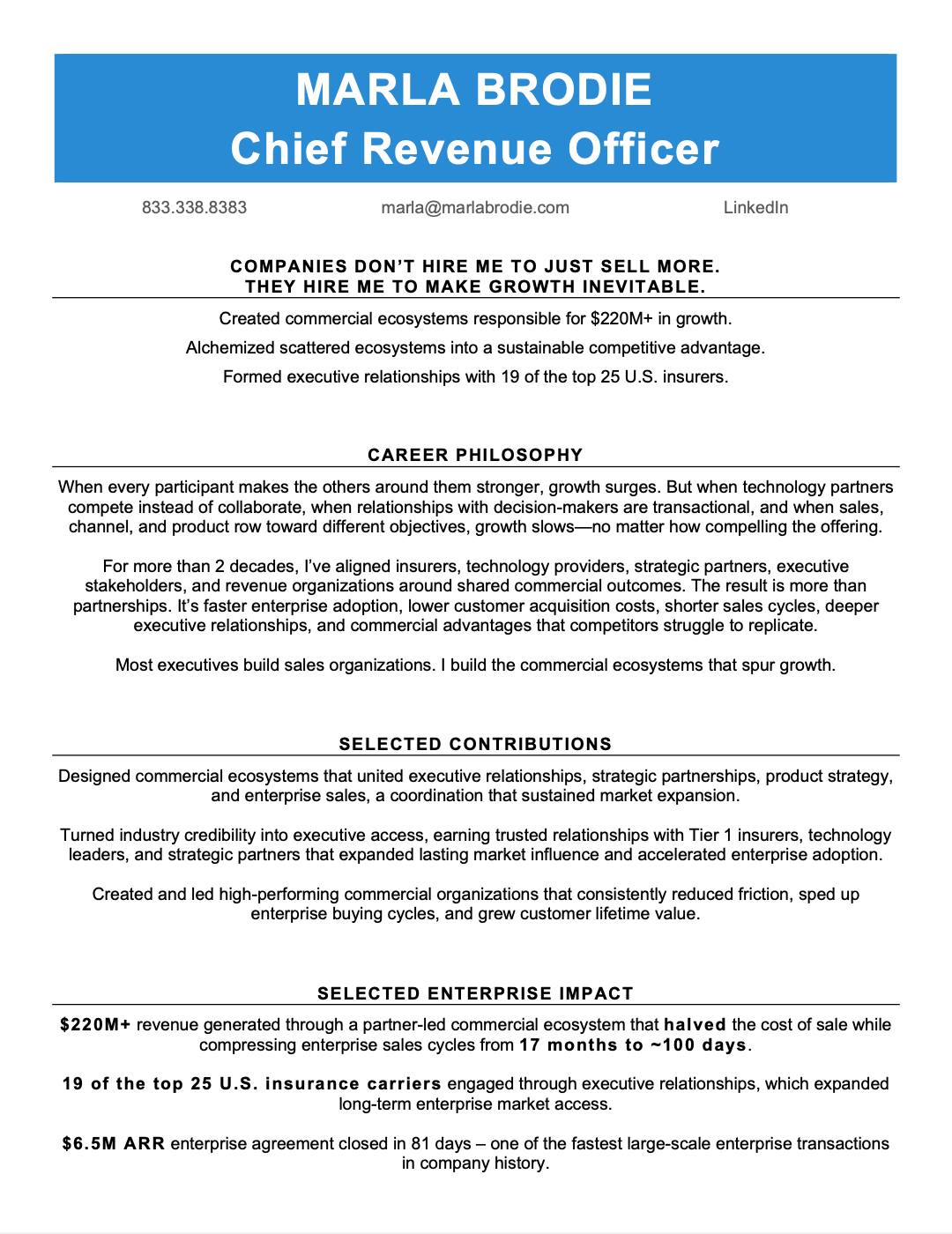
Marla’s original resume was built around accomplishments, but it was her operating philosophy that made those accomplishments possible. Marla understands that growth happens when commercial ecosystems are aligned around shared outcomes. That insight became the organizing principle for her entire resume.
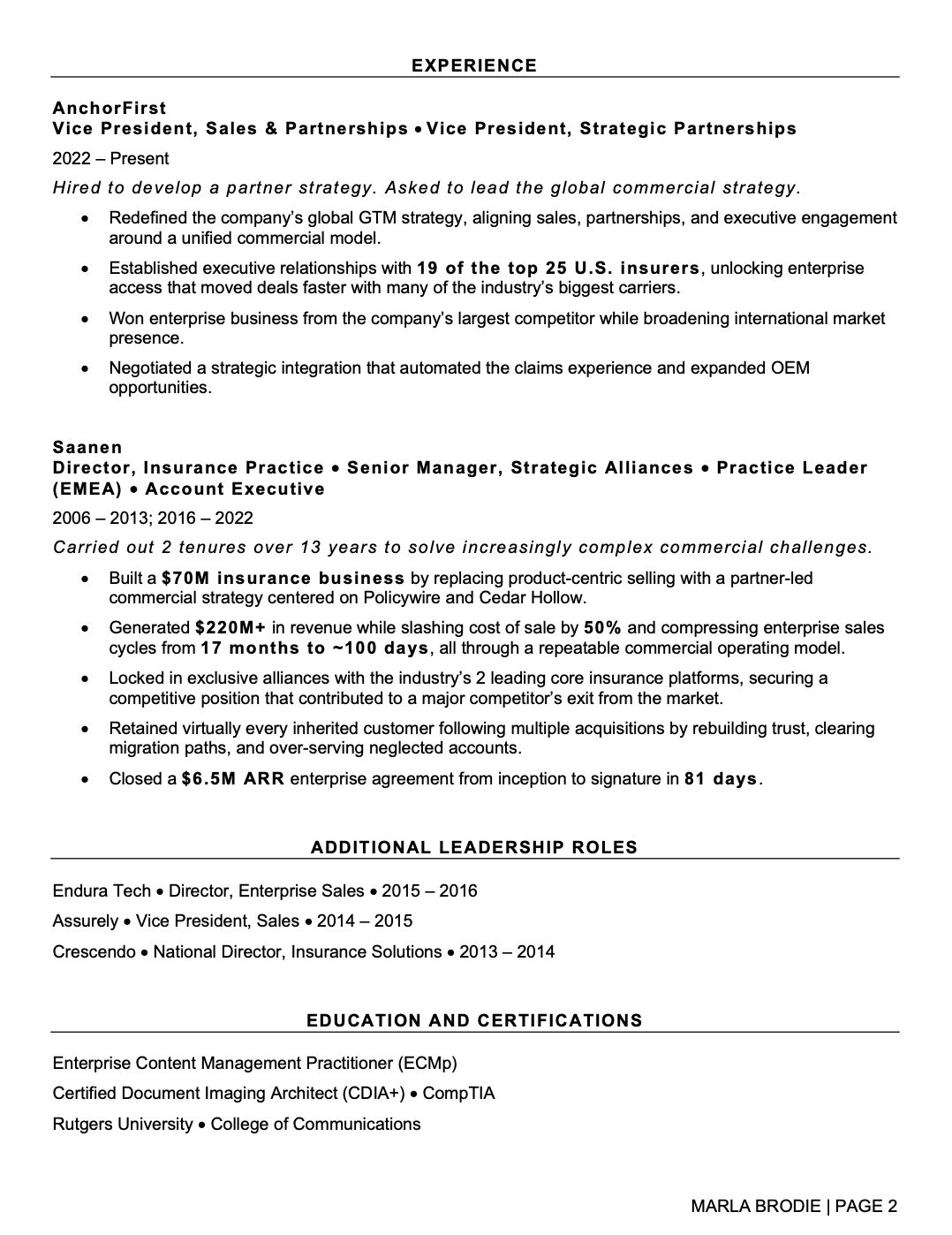
Instead of leading with a traditional executive summary, we introduced Marla’s leadership philosophy and used the remainder of her resume to prove it. The first page establishes the idea. The second page provides the proof. Every accomplishment was selected not just because it was impressive, but because it reinforced the same executive narrative.
We also made the deliberate decision to resist over-designing the document. Typography, pacing, and white space create an editorial reading experience and let Marla’s thinking, rather than decorative elements, remain the focal point.
The resume successfully repositioned Marla from a VP of Sales and Partnerships into her first Chief Revenue Officer role.
Becoming a CRO Requires More Than a Record of Sales Success
The strongest Chief Revenue Officer candidates do more than generate revenue. They understand why revenue moves—and how to build a commercial system that makes growth easier to repeat.
Marla was already doing that work. She had generated more than $200M in revenue, built relationships with 19 of the 25 largest U.S. insurers, reduced enterprise sales cycles from 18 months to approximately 100 days, and built a $70M insurance business through partner-led growth. But those accomplishments could still be read as evidence of an exceptional sales and partnerships leader.
To position Marla for her first Chief Revenue Officer role, the resume needed to reveal the larger idea behind the numbers: she does not simply pursue opportunities within a market. She engineers the commercial ecosystem that creates them.
The Situation
Marla had spent her career operating in complex insurance markets, where growth depends on more than direct sales.
Carriers, platform providers, channel partners, marketplaces, and enterprise buyers all influence how, and whether, revenue moves. Success requires someone who can align those parties around a shared commercial outcome.
Marla had repeatedly done exactly that. She had:
- Built relationships with 19 of the 25 largest U.S. insurers
- Created revenue through partnerships and enterprise sales
- Aligned direct and channel strategies
- Expanded market access through integrations and alliances
- Converted complex relationships into measurable commercial growth
The experience supported a CRO role. The existing narrative did not yet make the operating model behind that success visible.
What Wasn’t Working
The resume contained impressive results, but the reader was left to connect them.
- Revenue appeared without its underlying system. The numbers demonstrated performance, but not the commercial architecture responsible for it.
- Partnerships looked like a sales channel. They were presented as one component of the work rather than the mechanism through which Marla created access, speed, and scale.
- Relationships were treated as activity rather than infrastructure. The resume showed whom Marla knew and worked with, but not the competitive advantage those relationships created.
- The story emphasized execution. Deals, pipeline, and sales leadership were visible; the design of the broader revenue ecosystem was not.
- The candidate could still be categorized as a VP of Sales and Partnerships. Nothing was inaccurate, but the framing kept Marla anchored to the title she already held.
That final problem mattered most. A first-time CRO candidate cannot rely on a hiring team to infer executive scope from strong sales results. The resume must make the larger commercial model unmistakable.
What We Changed
1. Identified the Idea Behind the Accomplishments
We began with a simple question: What does Marla understand about growth that other revenue leaders may not?
The answer became the governing idea of the resume: growth accelerates when the participants in a commercial ecosystem are aligned around shared outcomes.
That idea explains why Marla’s partnerships produce more than referrals. They create enterprise access, shorten the distance between buyer and seller, reduce friction, and give the company a stronger position within the market.
Once that operating philosophy was clear, the resume no longer needed to manufacture an executive brand. It needed to reveal the one already present in Marla’s career.
2. Reframed Partnerships as Commercial Architecture
Marla was not merely “working with partners.” She was determining:
- Which relationships could unlock the market
- How direct and channel sales should reinforce one another
- Where integrations could reduce barriers to adoption
- How multiple organizations could benefit from the same commercial outcome
- Which alliances could create durable competitive advantage
This reframing elevated partnerships from a sales activity to a CRO-level growth strategy.
It also distinguished Marla from revenue leaders whose primary model is increasing pipeline volume or expanding the sales organization. Her advantage is not simply selling harder. It is designing a market in which selling becomes easier.
3. Made the Relationships Economically Meaningful
Relationships are frequently described on executive resumes as though their value were self-evident.
They are not.
We connected Marla’s access to top insurers, platform providers, and channel partners directly to what that access enabled:
- Faster enterprise sales
- Lower acquisition costs
- Greater marketplace reach
- Stronger distribution
- New recurring-revenue opportunities
- Defensible positioning within the insurance ecosystem
The relationships became evidence of commercial leverage, not a prestigious contact list.
4. Connected Every Major Result to the System That Produced It
The metrics were already impressive:
- More than $200M in revenue
- A 50% reduction in cost of sale
- Enterprise sales cycles reduced from 18 months to approximately 100 days
- A $6.5M ARR agreement closed in 81 days
- A $70M insurance business built through partner-led growth
But a collection of large numbers does not automatically create an executive narrative.
We selected and framed each result according to what it proved about Marla’s model. Revenue demonstrated the scale of the ecosystem. Shorter sales cycles demonstrated reduced friction. Lower cost of sale demonstrated efficiency. The $70M business demonstrated that the strategy could create an enduring commercial engine.
The accomplishments became evidence for an idea, not substitutes for one.
5. Designed the Resume as an Executive Argument
The resume does not open with a conventional summary packed with competencies and adjectives.
The first page establishes Marla’s point of view: sustainable revenue growth is created by aligning a commercial ecosystem. The remainder of the resume demonstrates that the idea has worked repeatedly and at scale.
The design follows the same logic. Typography, pacing, and white space create a restrained editorial experience. Visual elements guide the reader through the argument without competing with it. The document feels less like a career inventory and more like an executive briefing.
That restraint is deliberate. Marla’s thinking is the differentiator. The design exists to make that thinking easier to understand.
Why This Works
Hiring a Chief Revenue Officer is not simply hiring the person with the largest number.
Companies need to understand the candidate’s theory of growth:
- Where will new revenue come from?
- What prevents the company from reaching it now?
- Which parts of the commercial organization must work differently?
- How will the leader create access, speed, and scale?
- Can their success be repeated, or does it depend on individual dealmaking?
Marla’s resume answers those questions. It positions her as a revenue executive who can integrate partnerships, enterprise sales, platforms, and channels into one commercial system—and then shows the financial results that system can produce.
That is a more compelling CRO proposition than “proven sales leader,” because it explains not only what Marla has achieved, but why she is capable of doing it again.
The Bigger Point
Many first-time CRO candidates are already operating beyond the boundaries of their title.
They are influencing product strategy, building distribution, shaping partnerships, entering new markets, and creating the infrastructure through which revenue grows. But their resumes continue to organize that work around sales activities and isolated accomplishments.
The problem is not a lack of executive experience. It is that the resume has not identified the executive idea connecting it. Marla did not need more revenue metrics to look like a CRO. She needed the existing metrics to prove something larger: She builds commercial ecosystems that expand access, accelerate revenue, and make growth more durable.
Once that idea became visible, the transition from VP of Sales and Partnerships to Chief Revenue Officer no longer looked like a promotion based on potential. It looked like the appropriate title for the work she was already doing.
The Result
The completed resume repositioned Marla from a VP of Sales and Partnerships into an ecosystem-driven revenue executive. Within five months, she landed her first Chief Revenue Officer role.
*Client details have been modified to protect confidentiality while preserving the strategic positioning and outcomes.
Ready to Fix the Gap?
If your resume shows impressive revenue results but does not explain the commercial model behind them, hiring teams may see a strong sales leader without recognizing the Chief Revenue Officer already doing the work.
I help senior leaders turn complex careers into clear, differentiated executive narratives, so the market can understand not only what they have accomplished, but how they create value and why their success is repeatable.