
Chief Technology Officer Resume Example
From Technical Leader to Market-Ready CTO: Positioning for Executive-Level Impact
The Situation
On paper, this client had everything most technical leaders work for:
- CTO experience at an IBM subsidiary
- A $100M product launch at IBM
- Deep expertise in data platforms, cloud infrastructure, and AI systems
And yet, the resume didn’t reflect that level of impact. It read like a strong technical operator: someone highly capable, but not clearly positioned as a technical executive driving business outcomes.
If you’ve operated at this level, you might recognize the pattern. Your work is complex, your impact is real, but the story doesn’t quite translate on paper.
Because at this level, hiring decisions aren’t about whether you can do the job. They’re about whether you’re perceived as already operating at that level.
What Wasn’t Working
The original resume had solid content, but the positioning was off in a few important ways:
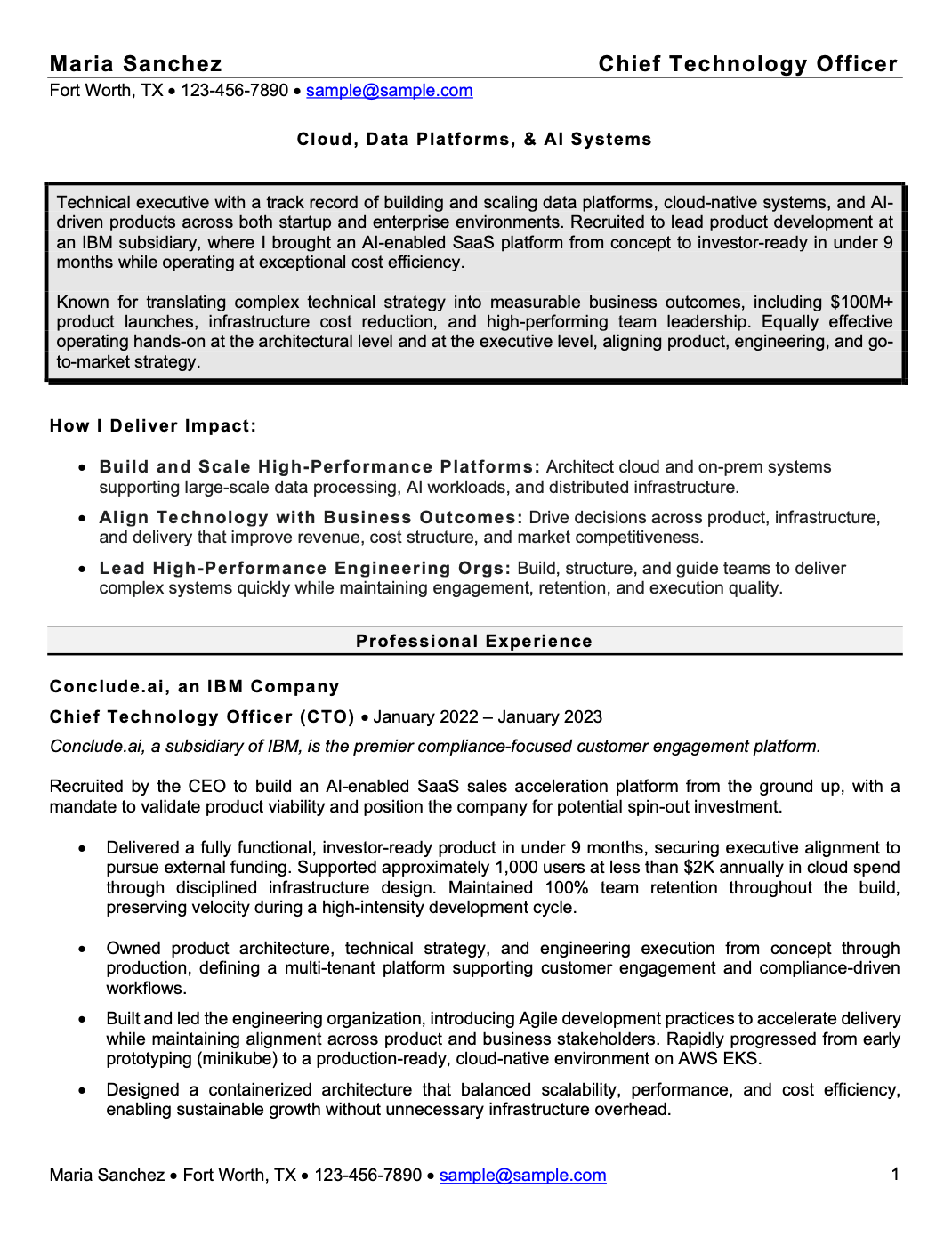
- Executive experience wasn’t leading the story. The CTO role was present, but not clearly framed as the centerpiece of the narrative.
- Too much emphasis on technical execution. The resume showed what was built, but not what was owned or driven.
- Business impact was undercommunicated. Metrics were there, but they weren’t doing the heavy lifting they should have been.
- The narrative felt fragmented. Enterprise experience, startup leadership, and hands-on technical work weren’t connected into a clear throughline.
This is especially common for technical leaders who’ve spent most of their careers being evaluated on execution. The work gets done. The systems scale. But the narrative doesn't fully keep pace with the level they’re actually operating at.
At this level, it’s rarely about capability. It’s about whether your experience reads at the level you’re already operating.
What We Changed
We didn’t add anything that wasn’t already true. We changed how the story was told.
1. Re-centered the narrative around executive ownership
Instead of presenting this as a technical leader with a range of experiences, we made it clear:
This is a technical executive who has:
- Been recruited into a CTO role
- Owned product and architecture decisions
- Delivered outcomes that matter to the business
Language shifted from participation to ownership:
- Collaborated → Owned
- Contributed → Defined / Led / Delivered
2. Made the CTO role the anchor
The CTO experience became the center of gravity:
- Recruited by the CEO
- Built a product from 0→1
- Delivered an investor-ready platform in under 9 months
- Operated at extreme cost efficiency
This is the kind of story that signals “This person can operate at the executive level under pressure.”
3. Connected technical decisions to business outcomes
Instead of listing technical achievements in isolation, we tied them directly to impact:
- Infrastructure decisions → cost efficiency (<$2K annual cloud spend)
- Product delivery → investor readiness in 9 months
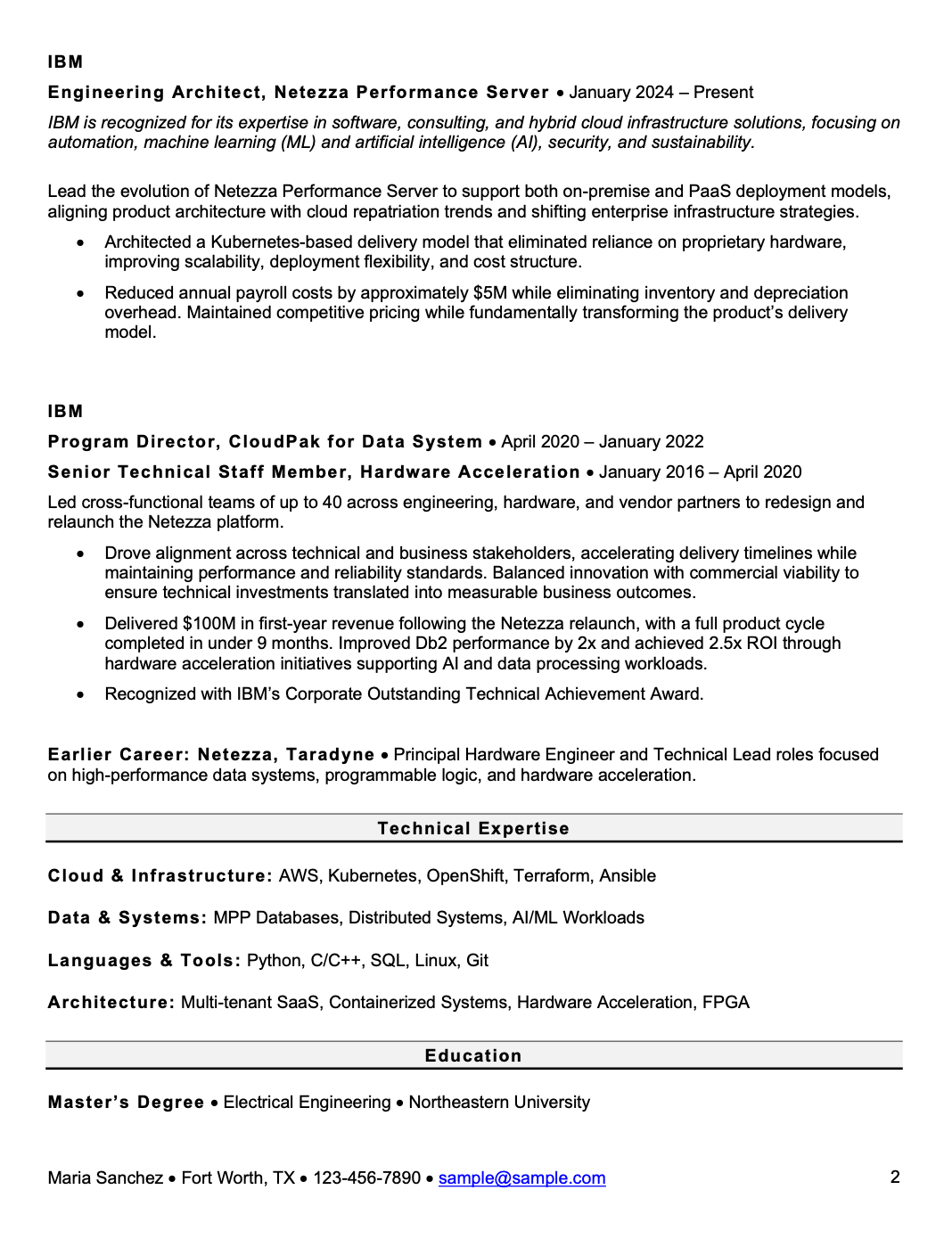
- Platform redesign → $100M in first-year revenue
At this level, technical credibility is assumed. What matters is what those decisions enabled.
4. Unified the career narrative
One of the biggest shifts was subtle. We connected:
- Enterprise leadership (IBM)
- Startup execution (CTO role)
- Deep technical expertise
…into a single, coherent story: A leader who can build at the architectural level, operate at the executive level, and deliver at commercial scale.
Why This Works
This resume works because it aligns with how senior technical leaders are actually evaluated.
Not on how many tools they’ve used or how detailed their architecture descriptions are, but on scope of ownership, ability to deliver outcomes, and credibility across technical and business contexts.
It answers the unspoken questions hiring teams are asking:
- Can this person lead at the executive level?
- Can they translate technical complexity into business value?
- Have they done this in environments that look like ours?
And it answers them quickly.
The Bigger Point
Most senior technical professionals don’t need better experience. They need clearer positioning. If you’ve ever looked at your resume and thought, “This is accurate, but it doesn’t really reflect me,” that’s exactly the gap we’re addressing.
The difference between a “strong technical leader” and a “hireable CTO” is rarely capability. It’s how the story is told.
*Client details have been modified to protect confidentiality while preserving the strategic positioning and outcomes.
Ready to Fix the Gap?
If your resume doesn’t clearly reflect the level you’re operating at, you’re leaving opportunities on the table.
I work with senior leaders to reposition their experience so it lands the way it should..