
Director, R&D
Elevating Deep Technical Expertise into Strategic R&D Leadership
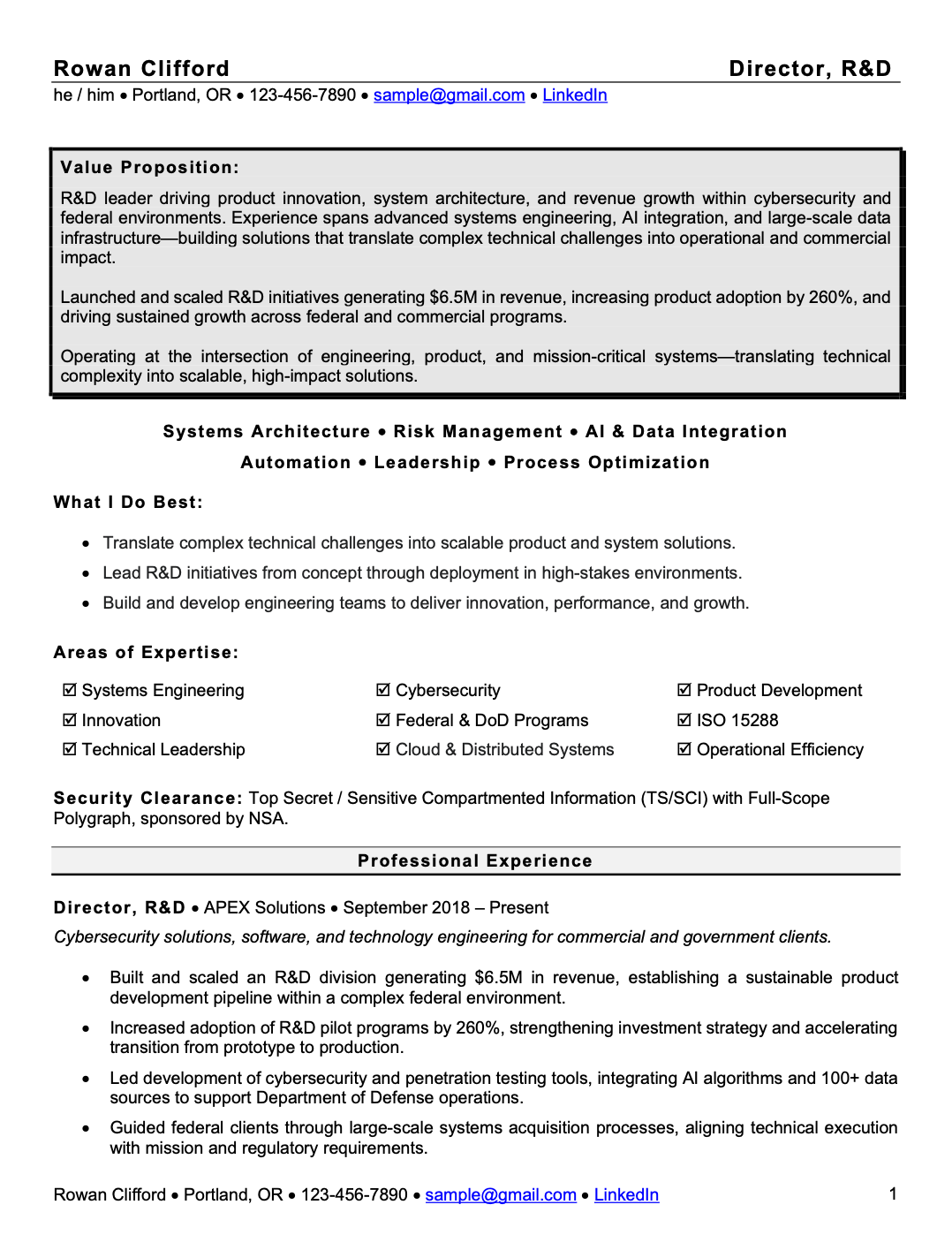
If your work involves leading complex systems, driving innovation, and shaping technical direction—but your resume still reads like an individual contributor, you’re likely being evaluated below your actual level.
The Situation
This client had built a career in highly technical, high-stakes environments. They had led R&D initiatives in cybersecurity and federal programs, worked directly with DoD systems and requirements, and owned complex engineering efforts spanning AI, data integration, and systems architecture
The work was sophisticated and the impact was real, but the resume didn’t reflect the level of ownership behind it.
It leaned heavily into systems engineering (tools, frameworks, technical execution) without clearly showing how that work translated into leadership, product development, or business outcomes.
If you’ve spent your career in technical roles, this is a common pattern. The deeper your expertise, the easier it is for your resume to over-index on detail and under-signal scope.
The more technical your work becomes, the harder it is for others to quickly understand the level you’re operating at, so you end up with a resume that proves you’re capable, but doesn’t clearly show what you own.
What Wasn’t Working
The issue wasn’t the experience. It was how it was being interpreted.
- The narrative was too IC-focused. “Lead Systems Engineer” and similar framing positioned the client as an advanced individual contributor, not a Director-level leader.
- Technical detail overshadowed business impact. The resume showed how things were built, but not what they drove.
- R&D work wasn’t clearly tied to outcomes. Revenue, adoption, and product development were present, but not leading the story.
- The structure reinforced execution, not ownership. The format made the work feel task-oriented rather than strategic.
This is especially common in R&D and systems engineering roles. The more complex the work, the harder it is to communicate level.
What We Changed
We didn’t simplify the work, we changed how it was framed.
1. Shifted from technical execution to ownership
Instead of positioning the client as someone who builds systems and solves technical problems, we positioned them as someone who:
- Defines technical direction
- Leads R&D initiatives
- Owns outcomes
That shift changes how every line is interpreted.
2. Connected engineering work to product and revenue
The original resume showed impressive technical work. We needed to make it clear what that work produced:
- $6.5M in R&D revenue
- 260% increase in product adoption
- Sustained growth across federal programs
Now the question: “Why does this matter?” is already answered.
3. Elevated R&D to a business function
R&D can easily read as experimental or exploratory. We reframed it as:
- Product pipeline development
- Commercialization
- Strategic investment
This positions the role as a driver of growth, not just innovation.
4. Removed structure that reduced the perceived level
The format was clear but limiting. We replaced it with:
- Impact-first bullets
- Ownership language
- Tighter, more direct phrasing
Now it reads like a leader describing outcomes, not a report describing work.
Why This Works
Technical leaders are often evaluated on the wrong signals. Hiring teams don’t need to understand every detail of the system. They need to understand:
- What you own
- What you drive
- What changes because of your work
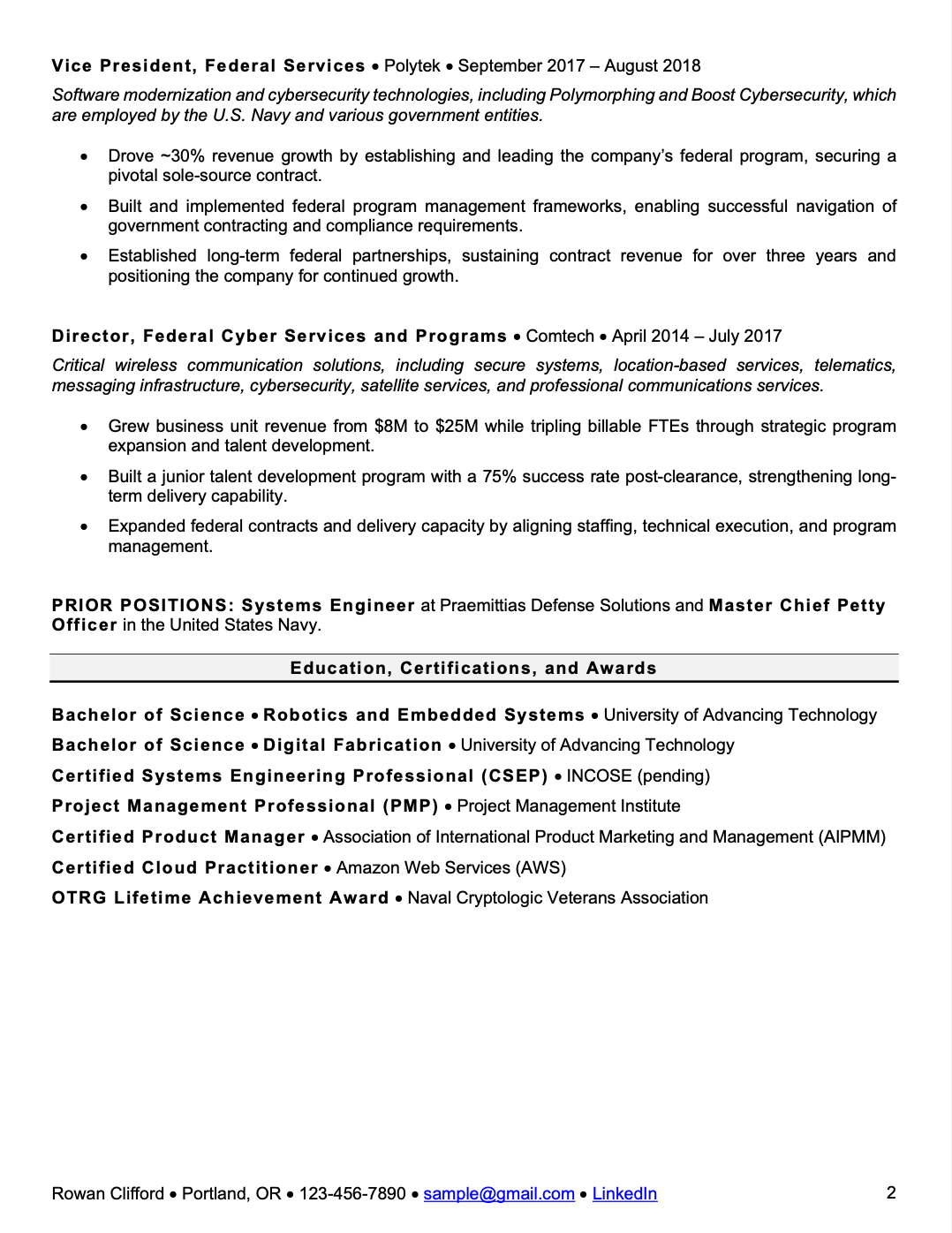
This resume makes that clear. It shows someone who leads R&D initiatives, translates technical complexity into real-world outcomes, and operates at the intersection of engineering, product, and business.
The Bigger Point
A lot of technical leaders run into this. If you’ve ever thought, “I’m doing more than my resume shows, but I don’t know how to translate it,” you’re not wrong.
The gap isn’t your experience. It’s how that experience is framed.
The difference between “advanced technical contributor” and “technical leader driving innovation and growth” comes down to how clearly ownership and impact are communicated.
*Client details have been modified to protect confidentiality while preserving the strategic positioning and outcomes.
Ready to Fix the Gap?
If your resume emphasizes technical detail but doesn’t clearly show what you own, drive, and deliver, you’re likely being evaluated below your actual level.
I work with senior leaders to reposition their experience so it lands the way it should.