
VP, Revenue Operations
Driving Revenue Operations at Scale Across Complex Enterprise Environments
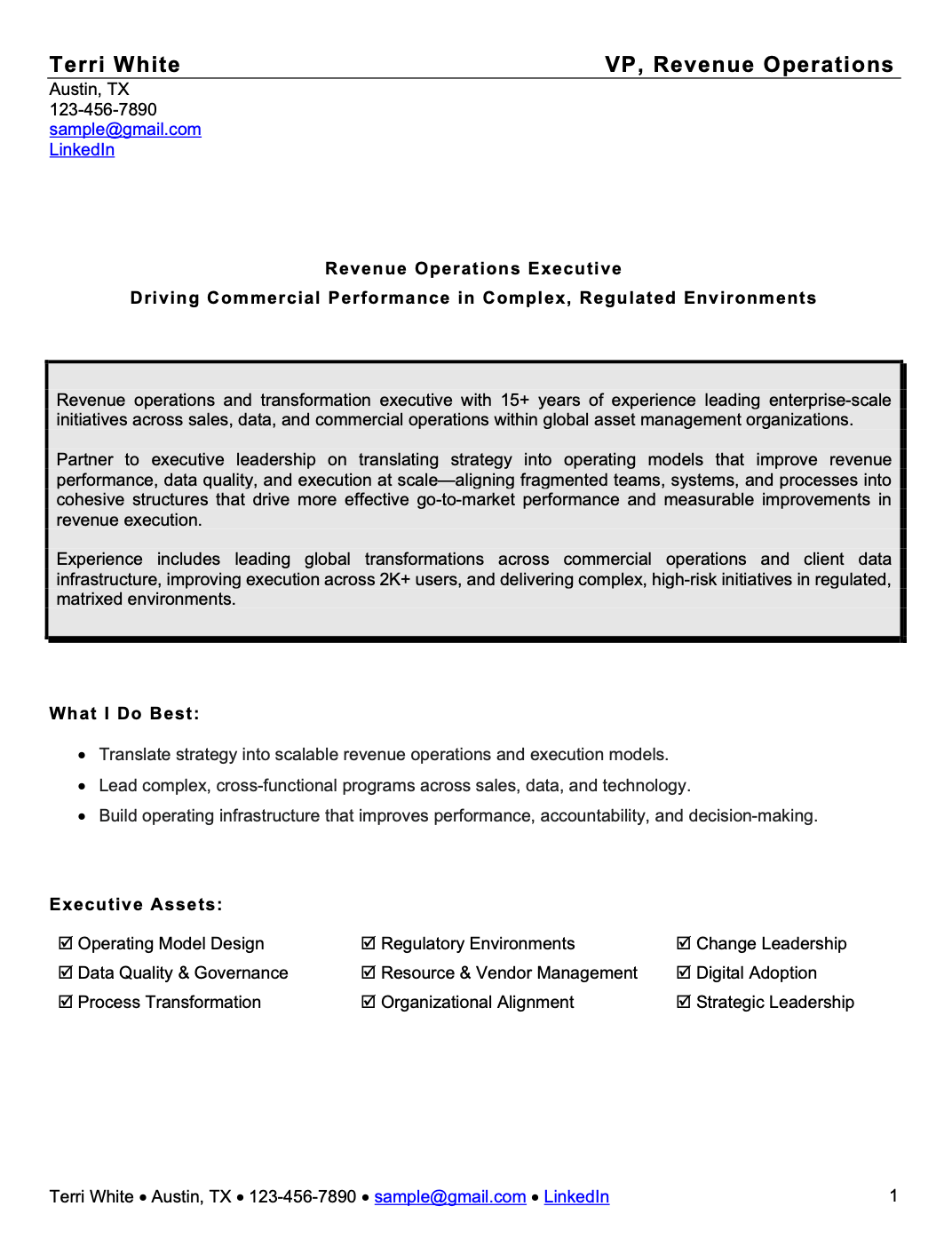
If your work sits at the center of revenue but your resume reads like support rather than ownership, you’re almost always evaluated below your actual level.
The Situation
This client had built a career inside complex, global organizations doing exactly the kind of work companies depend on, but don’t always know how to evaluate:
- Leading large-scale transformation across sales, data, and client operations
- Owning CRM, governance, and execution across regions
- Driving improvements that directly impact how revenue moves through the business
The impact was real, the scope was real, but the resume didn’t quite land that way. It leaned operational. Execution-focused. Important work, but not clearly owned.
If you’ve worked in revenue operations, this probably sounds familiar. You’re touching everything—sales, marketing, data, systems—but because of that, it’s harder to point to one clean “thing” you own. And that’s exactly where strong candidates get underestimated.
What Wasn’t Working
Nothing was wrong with the experience itself. It was how it showed up on paper.
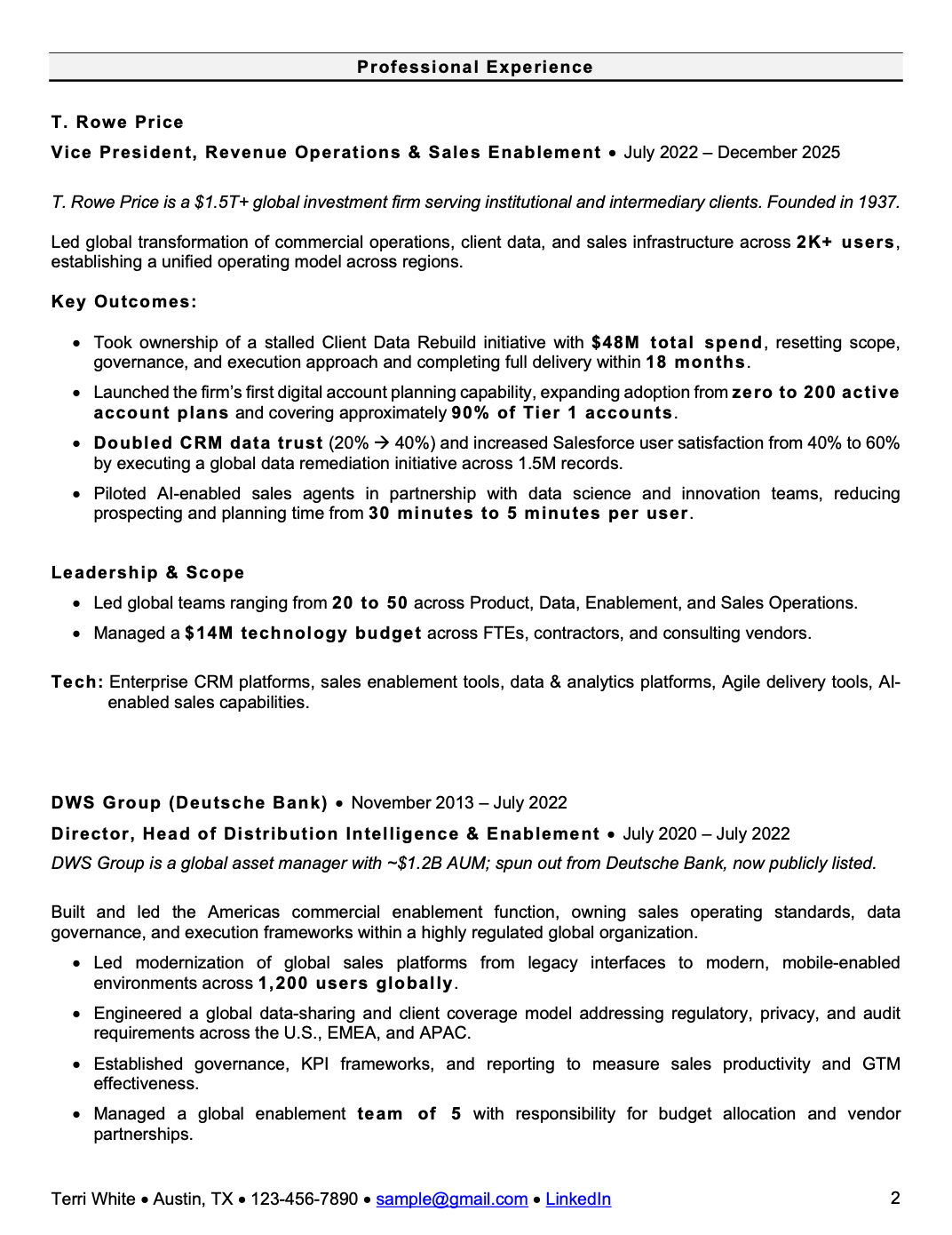
- Revenue impact was implied, not stated. The work clearly influenced performance—but it wasn’t explicitly tied to revenue outcomes.
- Systems ownership read as support. CRM, data, and process work came across as maintenance rather than architecture.
- Cross-functional scope wasn’t obvious. The role spanned multiple teams and regions, but that complexity wasn’t fully visible.
- The story felt fragmented. Strong initiatives, but no clear throughline connecting them into a single narrative.
This is one of the most common issues in RevOps. You’re responsible for how everything works, but because it’s distributed, it doesn’t always read as ownership of anything.
What We Changed
We didn’t add anything new. We made the existing impact easier to see and harder to ignore.
1. Re-centered the role around revenue
Instead of letting the work sit in “operations,” we pulled it into what it actually affects:
- Revenue performance
- GTM execution
- Customer and sales data quality
That shift alone changes how the entire resume is interpreted.
2. Reframed systems as infrastructure, not support
There’s a big difference between managing tools and defining how a business operates. We made it clear that this role wasn’t about maintaining systems, it was about owning the structure behind revenue execution.
3. Made scope visible
Global teams. Thousands of users. Multi-year initiatives. All of that was already true, it just wasn’t front and center. Once it is, the level becomes obvious.
4. Created a single, coherent narrative
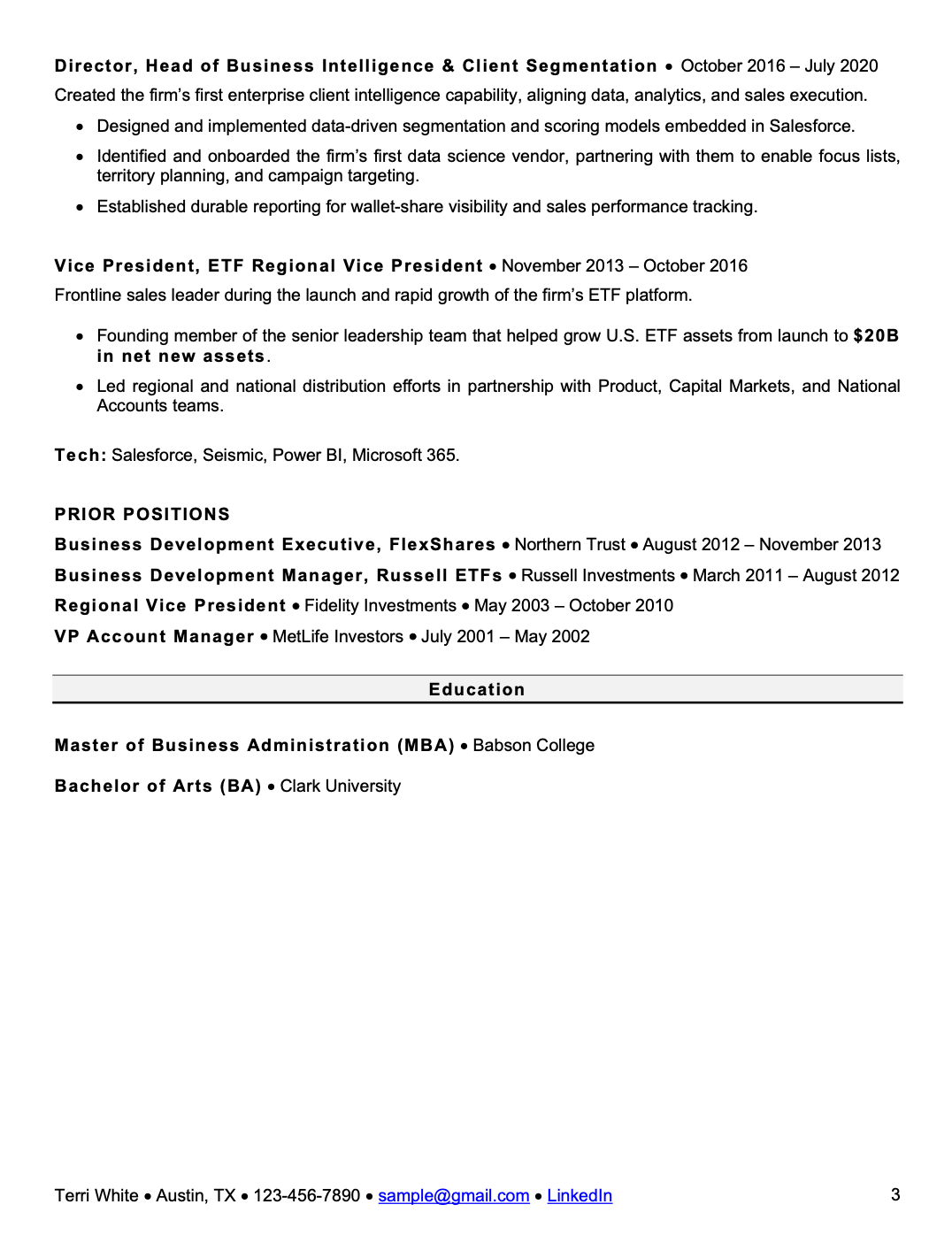
Before, it read like a series of strong initiatives. Now it reads like someone who steps into complex environments, brings structure to them, and leaves them operating better than before. That’s the throughline.
Why This Works
RevOps is one of those functions that’s critical, and also frequently misunderstood. At the executive level, no one is hiring for Salesforce management or process improvement. They’re hiring for someone who can make the business run more effectively.
This resume makes that clear without over-explaining it. It shows:
- Ownership
- Scope
- Impact
…and lets those speak for themselves.
That clarity didn’t just improve how the resume read; it held up in the market, resulting in a transition into an execution-focused strategy role within a global financial services organization.
The Bigger Point
A lot of senior RevOps leaders have this problem. If you’ve ever thought, “I know I’m driving impact, but it’s hard to explain exactly how”, that’s not a capability issue. It’s a positioning issue. The difference between “supports revenue operations” and “drives revenue performance across the business” comes down to how the work is framed.
*Client details have been modified to protect confidentiality while preserving the strategic positioning and outcomes.
Want a Resume Like This?
If your current resume isn’t generating interviews, the issue is often not your experience. It’s how your experience is being positioned.
Work with one of the world’s few Certified Executive Resume Writers to create a resume designed to stand out to hiring managers and recruiters.