
VP, Business Development
Positioning Business Development Leadership for Revenue, Partnerships, and Growth
If your work drives partnerships, product expansion, and revenue but your resume doesn’t clearly show how those efforts translate into business outcomes, your impact is easy to underestimate.
The Situation
On paper, this client had everything you’d expect from a strong business development leader:
- VP-level experience at a leading financial institution
- Ownership of partnerships and digital product initiatives
- Direct contribution to revenue growth and customer acquisition
But the resume didn’t reflect that level of impact. It read like execution, not ownership.
If you’ve worked in business development, you’ve probably felt this tension. You’re influencing product, driving partnerships, and contributing to growth, but your resume doesn’t clearly connect the dots.
At this level, that’s the difference between being seen as someone who supports the business
and someone who
drives it.
What Wasn’t Working
The underlying experience was strong, but the positioning wasn’t.
- Revenue wasn’t the headline. The numbers were there, but they weren’t doing the work they should have been.
- Partnerships read as activity. It showed involvement, but not ownership of strategy or outcomes.
- Product and growth felt disconnected. The relationship between partnerships, product, and revenue wasn’t clearly articulated.
- The tone leaned execution-heavy. It described what was done, not what was driven.
This is common in business development roles, especially inside large organizations. The work is cross-functional. The impact is real. But the narrative doesn’t always catch up.
What We Changed
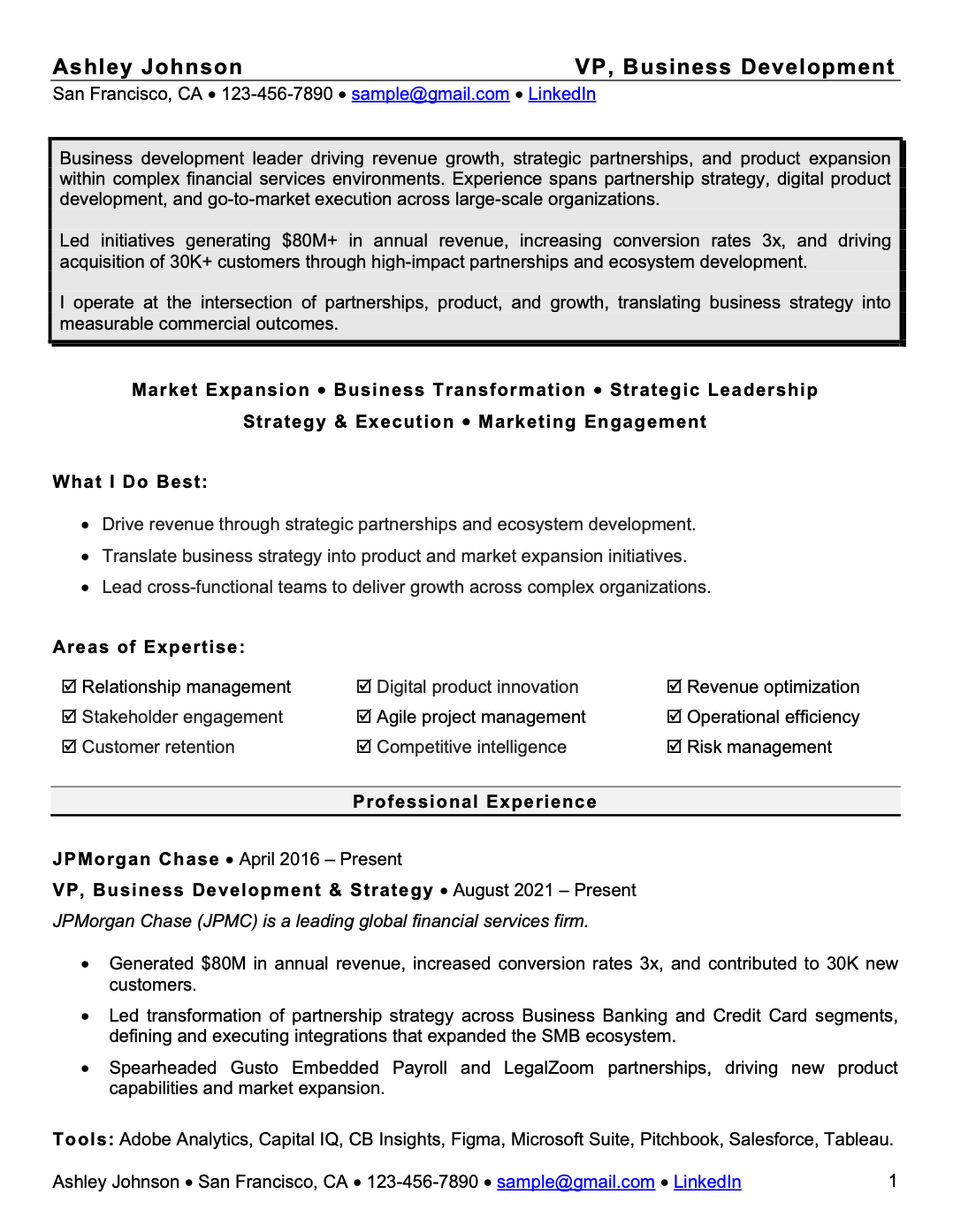
We didn’t add anything new. We just made the impact impossible to miss.
\
1. Made revenue the anchor
Instead of letting metrics sit in the background, we brought them forward:
- $80M in annual revenue impact
- 3x increase in conversion rates
- 30K new customers driven through partnerships
Now the story is clear: this is someone who drives growth.
2. Shifted partnerships from participation to ownership
We reframed the role to show:
- Ownership of partnership strategy
- Ownership of pipeline and execution
- Ownership of outcomes
Not “worked on partnerships,” but defined and drove them.
3. Connected partnerships to product and customer impact
Business development doesn’t operate in a vacuum. We made the relationship explicit:
- Partnerships → product integrations
- Product → customer value
- Customer value → revenue growth
Now it reads as a system—not a list of initiatives.
4. Elevated the level of the role
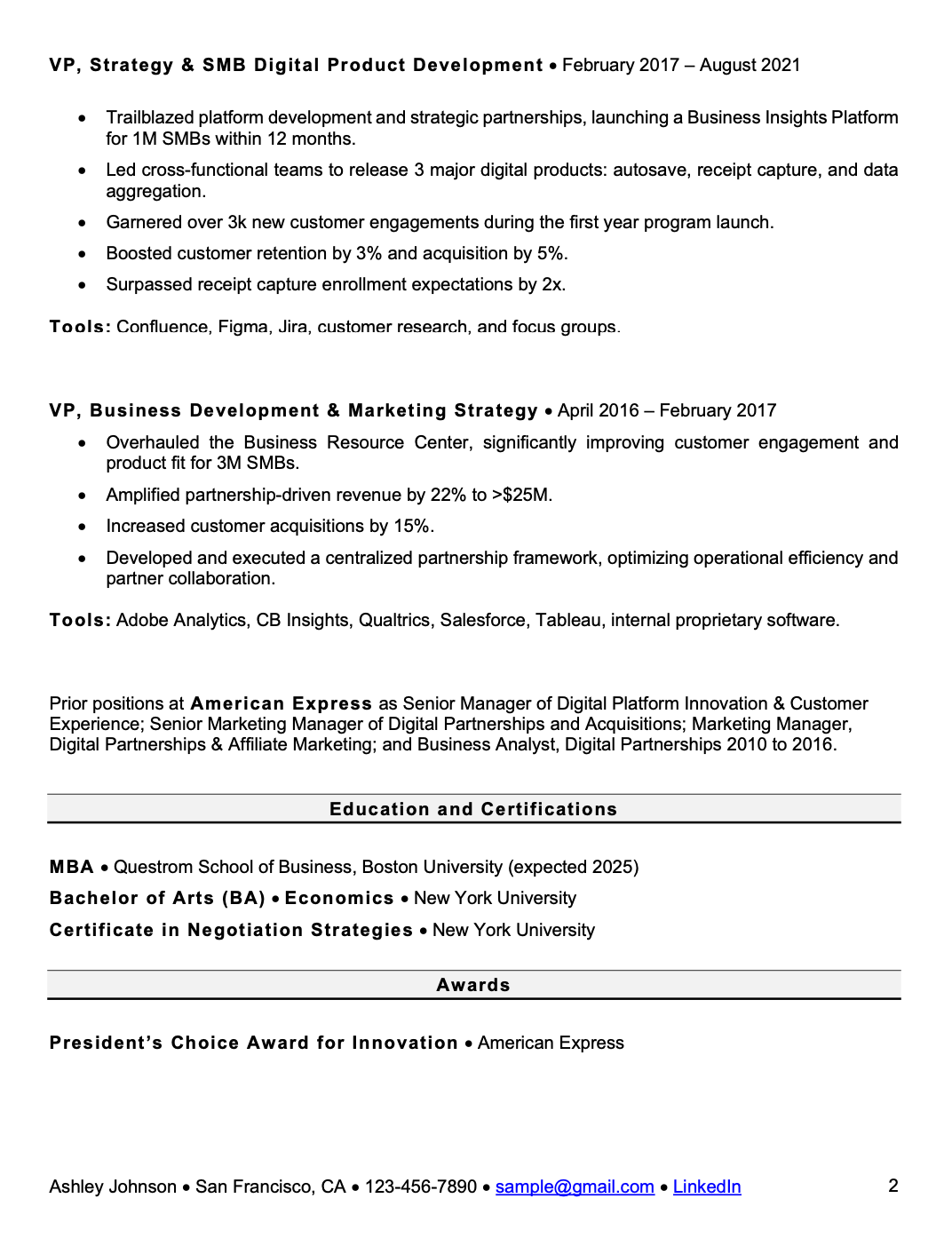
Subtle changes, big difference, like stronger verbs, clearer scope, and tighter alignment to business outcomes. The result is that this reads like a VP operating at the executive level, not a strong operator executing within it.
Why This Works
At the executive level, business development is evaluated on 3 things:
- Did it drive revenue?
- Did it expand the business?
- Did you own the strategy behind it?
This resume answers all 3 quickly and clearly. It positions the client as someone who drives growth, owns partnerships, and translates relationships into measurable outcomes.
The Bigger Point
Business development professionals often have more impact than their resumes show. If you’ve ever looked at your resume and thought, “This is accurate, but it’s not capturing the full picture,” that’s the gap.
The difference between “works in business development” and “drives revenue and market expansion” isn’t usually experience. It’s positioning.
*Client details have been modified to protect confidentiality while preserving the strategic positioning and outcomes.
Ready to Fix the Gap?
If your resume doesn’t clearly connect your work to revenue, growth and business impact, you’re likely being evaluated below your actual level.
I work with senior leaders to reposition their experience so it lands the way it should.