
VP, Software Engineering
From Director to VP: Positioning for Executive-Level Impact
This resume was designed around a single idea: great engineering leaders improve systems, not just software.
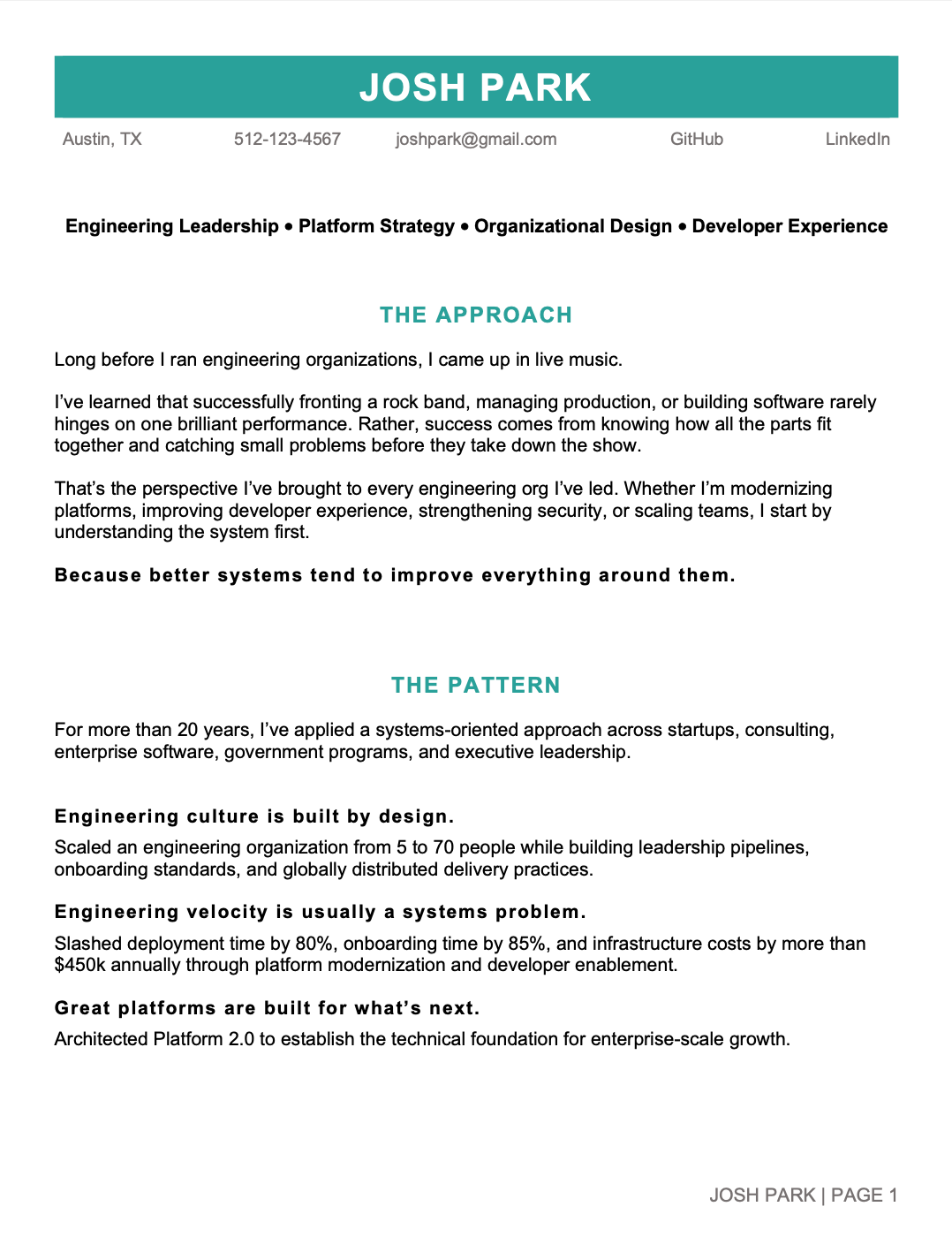
Rather than opening with a traditional executive summary, we introduced Josh’s leadership philosophy through an authentic story about their background in live music. That experience shaped the systems thinking that appears consistently throughout their engineering career.
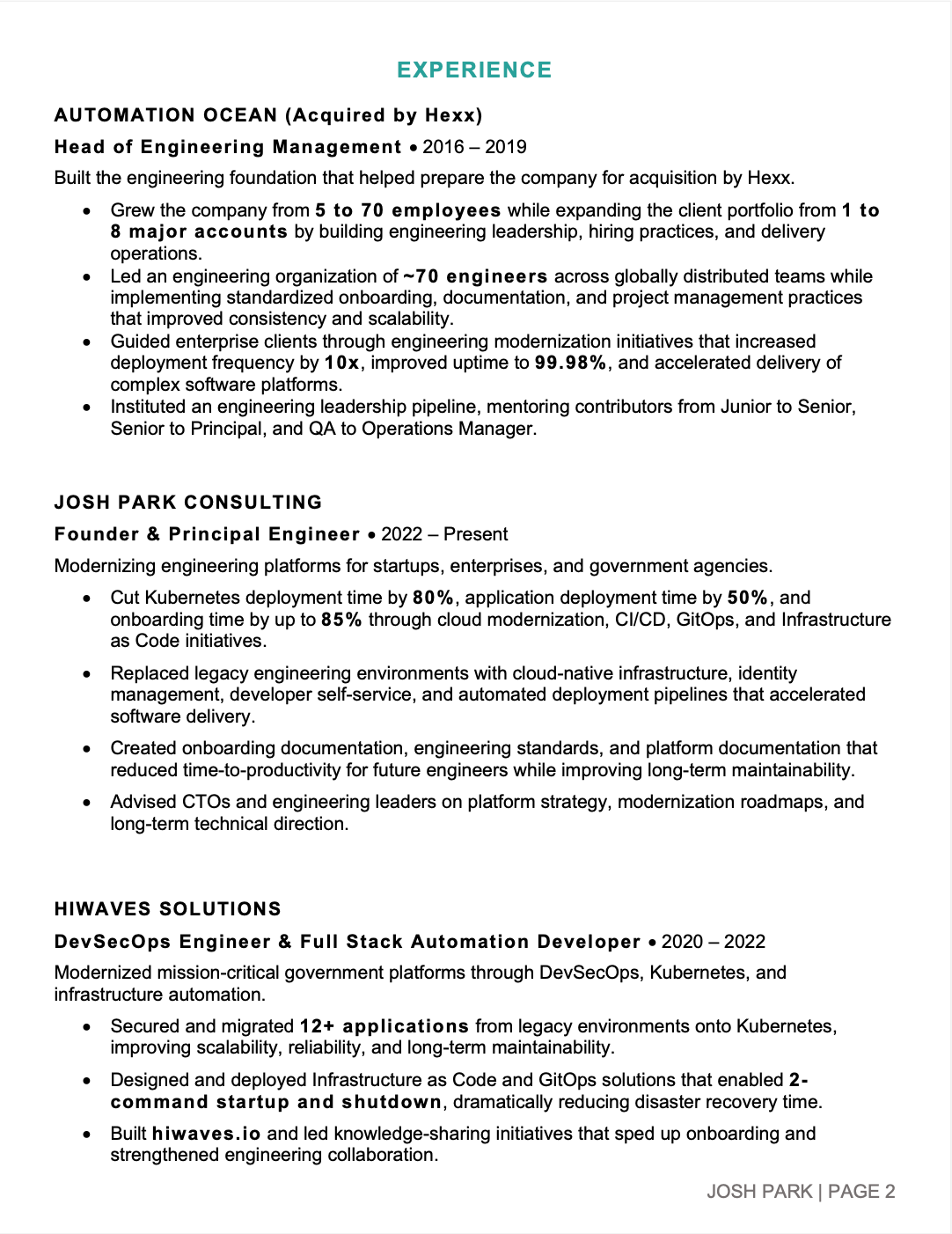
The first page establishes that perspective before presenting evidence through measurable outcomes. The experience section reinforces the narrative by organizing roles that best demonstrate organizational transformation, platform modernization, and engineering leadership.
Every accomplishment was selected to answer the same question: how does this leader leave engineering organizations better than they found them?
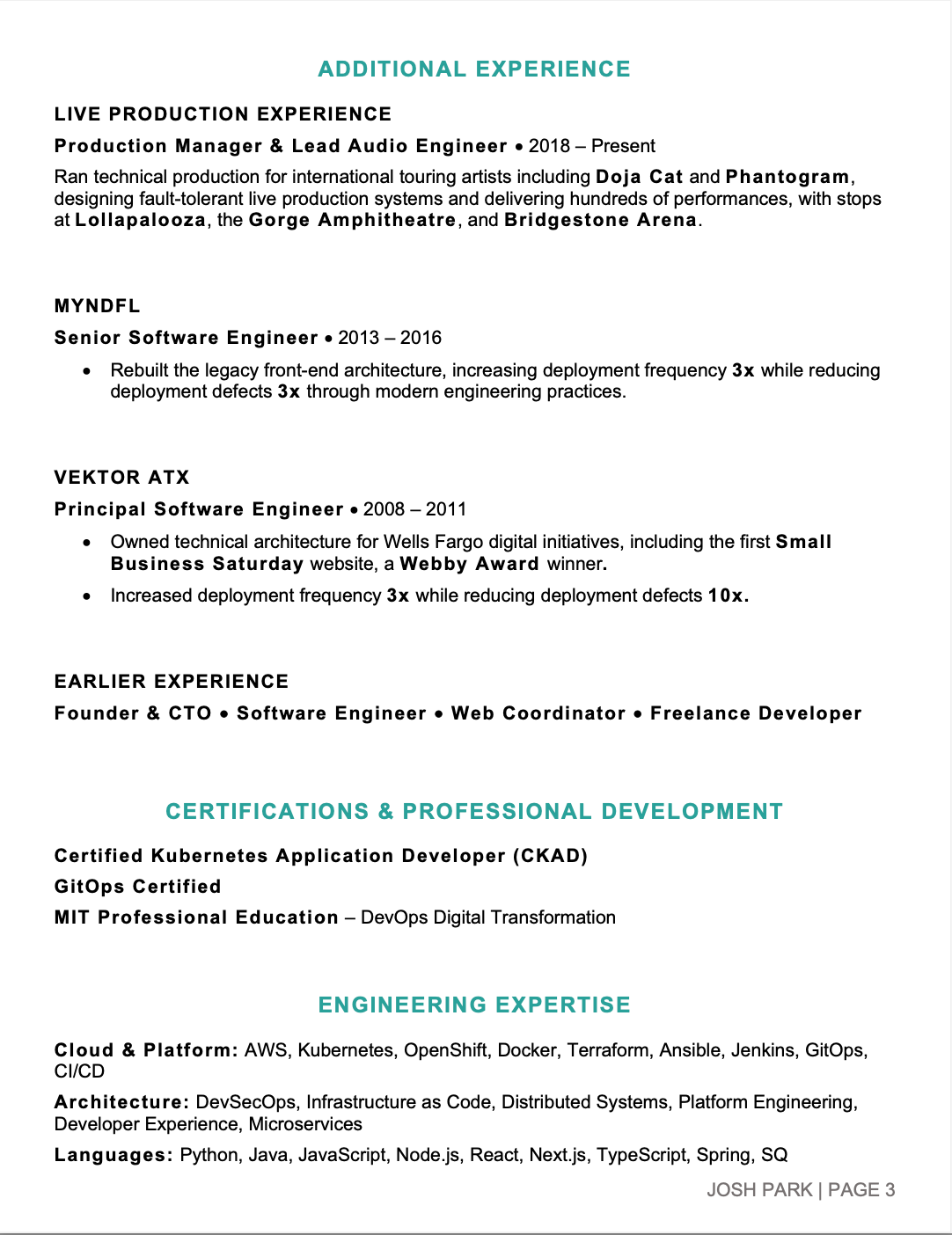
The roles aren’t presented in reverse-chronological order, a deliberate choice. Because this is a functional resume, the most relevant, impressive roles lead, and everything else follows. The strongest evidence sits where a reader’s attention is heaviest.
The result is a resume that communicates not only what Josh has accomplished, but how they think, a distinction that becomes increasingly important at senior technical leadership levels.
This resume successfully positioned Josh into their first VP of Software Engineering role.
*Client details have been modified to protect confidentiality while preserving the strategic positioning and outcomes.
Moving from Director of Engineering to VP Is a Positioning Problem
Engineering leaders are often promoted because they can diagnose complicated systems, strengthen teams, and make technology organizations work better. But their resumes frequently reduce that leadership to a collection of migrations, releases, tools, and delivery metrics.
That was the challenge here. Josh had already led organizational transformations, modernized platforms, and improved engineering performance. The experience supported a Vice President of Software Engineering role, but the resume did not yet communicate a distinctive executive identity.
To make the Director-to-VP transition, Josh needed more than a stronger list of accomplishments. They needed a resume that showed how they think, what they change, and why engineering organizations become more effective under their leadership.
The Situation
Josh had built a career at the intersection of software architecture, engineering leadership, and organizational transformation.
They had:
- Scaled and restructured engineering organizations
- Modernized complex platforms and development practices
- Improved delivery, reliability, and team effectiveness
- Led through periods of rapid growth and significant change
The qualifications were there. The problem was that the career story could easily be interpreted as a series of separate technical and operational achievements.
What connected those achievements, and distinguished Josh from other engineering leaders, was their ability to understand how people, processes, platforms, and business priorities interact as one system.
That idea needed to become the center of the resume.
What Wasn’t Working
The original positioning communicated extensive engineering experience, but it did not fully capture the leadership philosophy behind the results.
- The story was fragmented. Strong accomplishments appeared across multiple roles, but the reader had to determine what connected them.
- Technical work competed with executive value. Platform and software details demonstrated credibility without always showing what Josh changed at the organizational level.
- The chronology obscured the strongest evidence. A conventional reverse-chronological structure would have prioritized recency over relevance.
- The resume showed what Josh had done, but not how they think. It lacked the memorable idea that could distinguish them from other Director- and VP-level engineering candidates.
This is a common problem in software engineering executive resumes. The candidate has led meaningful transformation, but the document still reads like an inventory of responsibilities and technical accomplishments.
What We Changed
1. Built the Resume Around a Leadership Philosophy
The resume opens with an authentic story from Josh’s background in live music. That story is not there for personality alone. It introduces the systems thinking that defines their leadership: the understanding that individual components cannot perform at their best unless the entire environment works together.
That same principle appears throughout Josh’s engineering career. They do not simply improve software. They strengthen the organizational systems responsible for building it. The story gives the reader a lens through which to interpret everything that follows.
2. Positioned Engineering as an Organizational System
Rather than presenting platform modernization, team development, process improvement, and technical strategy as separate competencies, we connected them. The resume shows Josh working across people, processes, platforms, and product and business priorities.
This changes the candidate’s perceived level. Josh no longer reads as a technical leader responsible for individual engineering outcomes. They read as an executive who understands how to improve the entire engineering organization.
3. Replaced Chronological Convention with Strategic Relevance
We made the deliberate decision not to present Josh’s roles in traditional reverse-chronological order. Instead, the experience is organized functionally, allowing the roles with the strongest evidence of organizational transformation and executive leadership to appear first.
That is an unconventional choice, but it serves a clear strategic purpose. A resume is not required to give every experience equal prominence. Its job is to help the reader understand why the candidate is right for the role they want next. For Josh, that meant putting the most relevant proof where attention is highest.
4. Connected Technical Accomplishments to Leadership Impact
The resume retains enough technical context to establish credibility, but the technology is not the protagonist.
Each accomplishment was evaluated according to a larger question: What became stronger because Josh led it?
That shifted the emphasis toward:
- Healthier engineering organizations
- Stronger development practices
- More scalable platforms
- Better-performing teams
- Greater organizational effectiveness
The result is a VP Software Engineering resume that demonstrates technical depth without positioning Josh as primarily a hands-on technical operator.
5. Made the Director-to-VP Transition Feel Earned
Simply adding “executive leader” to a summary would not have made Josh appear ready for a vice president role. The resume needed to demonstrate a broader level of ownership.
By connecting organizational design, platform strategy, team leadership, and business impact, we showed that Josh was already solving VP-level problems. The next title became a logical continuation of the work—not an aspirational leap.
Why This Works
Senior software engineering leaders are rarely hired based on technical knowledge alone. Hiring teams want to understand:
- Can this person improve the organization, not just the product?
- Can they connect engineering decisions to broader company priorities?
- Can they lead people and systems through change?
- Do they have a clear philosophy for building effective engineering organizations?
- Are they already operating at the scope expected of a vice president?
This resume answers those questions through a unified narrative rather than a collection of unsupported claims.
Josh’s personal story establishes the philosophy. Their accomplishments provide the evidence. The structure ensures the strongest evidence is seen first. Together, those choices create something more valuable than a record of career progression: a memorable executive identity.
The Bigger Point
The difference between a Director of Engineering resume and a VP of Software Engineering resume is not vocabulary. It is scope.
Director-level resumes often emphasize what the candidate delivered: platforms, products, processes, and team results. VP-level resumes must also communicate the system the leader creates around that work—how they shape organizations, improve decision-making, align engineering with the business, and build the conditions for sustained performance.
If you are already solving those larger problems but your resume still presents you as a collection of technical accomplishments, your experience may be evaluated below its actual level.
Josh did not need to become a different leader to earn a VP title. They needed a resume that made the leader they had already become impossible to miss.
The Result
The completed resume successfully repositioned Josh from Director-level engineering leadership into their first Vice President of Software Engineering role.
Ready to Fix the Gap?
If you are already improving engineering organizations but your resume still reads like a list of technologies, projects, and delivery accomplishments, you may be presenting yourself below the level at which you actually operate.
I help senior technology leaders turn complex careers into clear, differentiated executive narratives—so hiring teams can quickly understand not only what they have accomplished, but how they lead and why it matters.